

A while back, I came across an idea that completely shifted the way I look at progress and setbacks. As for what that idea was, it was a quote by Alex Hormozi, which said:
“It costs me a billion dollars a year to not know what to do to make a billion dollars.”
This explains that the highest cost in anyone’s journey is not money or time, but the things they don’t know yet. Every goal you haven’t reached has a hidden price, and that price is your lack of knowledge about how to reach it.
Alex Hormozi calls this “Ignorance Debt,” and it’s something almost everyone carries without realizing how heavy it is. If this concept isn’t clear yet, keep reading; it will make complete sense by the end.
Key Takeaways
- Ignorance Costs You: Not knowing what to do already has a real financial and time cost. The knowledge gap slows your progress every single day.
- Two Learning Paths: You either learn slowly through trial and error or quickly through guidance and proven frameworks. One drains years, the other accelerates results.
- Calculate Your Cost: To measure your ignorance debt, start by defining your goal and identifying what you don’t know. This shows the true price of staying stuck.
- Learn Faster Now: Smart learning replaces guesswork with clarity and structure. When you learn faster, you reach your goals faster.
What Is Ignorance Debt?
Ignorance debt is the price you pay for the things you don’t know yet. It shows up whenever you have a goal but lack the information or strategy required to reach it. Most people assume that “not knowing” simply means they’re not ready.
In reality, the knowledge gap is already costing them progress. This is why ignorance debt is never neutral.
Peter Drucker once said,
“The most serious mistakes are not being made as a result of wrong answers. The truly dangerous thing is asking the wrong questions.”
The Two Ways You Pay: Slow Trial-and-Error vs. Fast Skill Acquisition
Here are the two ways you pay for educating yourself and being successful:
1. Paying Slowly Through Trial and Error
Trial and error feels like a comfortable path because it gives you a sense of control. You work through ideas on your own, experiment at your own pace, and hope that eventually something clicks.
With this, you spend months testing strategies that don’t work, hoping the next idea will be different, but each wrong turn stretches the journey further. Over time, this creates an emotional toll that most people underestimate.
2. Paying Quickly Through Coaching or Mentorship
On the other side is the faster path, where you learn directly from people who have already solved the problems you’re trying to navigate. This approach shortens the journey by bypassing the long list of mistakes you would have made on your own.
Even though the upfront investment often feels intimidating, it becomes far cheaper once you understand what you’re actually saying. You avoid years of slow progress, prevent costly missteps, and reach your goals in a fraction of the time.
In fact, studies show that 70% of small businesses survive more than 5 years just because they receive the right mentoring.
Calculate Your Own Ignorance Debt: 5-Step Self-Assessment
Understanding your own ignorance debt becomes easier when you break it down into simple steps. This process helps you see the real cost of the things you haven’t learned yet, and it gives you a clear picture of how much you’re losing.
Here’s how you can calculate your own ignorance debt in five steps:
Step 1: Define Your Goal
Start with a clear, measurable goal. This could be a monthly income target, a business milestone, or a new skill you want to turn into opportunities. The more specific your goal is, the easier it becomes to calculate the cost of not achieving it.
Example: “I want to earn $10,000 per month from my business,” or “I want to transition into a remote aviation-based career.”
Step 2: List What You Don’t Know Yet
Write down the skills, systems, and knowledge gaps that are stopping you from reaching that goal. These are the areas that create your ignorance debt. Being honest here is important because clarity allows you to see exactly what needs to change.
For instance, you can list things like:
- I don’t know how to find clients.
- I don’t understand how to structure an offer.
- I am not sure how to build a lead system.
Step 3: Assign a Monthly Value to the Result
Every goal carries a financial or time-based value. If your goal is income-related, the value is straightforward. However, if your goal is career-related, you can estimate based on the salary range or the opportunities you would have access to once you reach it.
This number becomes your monthly ignorance debt. Like, if your goal is $10,000 a month and you’re earning $0 from it right now, your ignorance debt is $10,000 per month.
Step 4: Calculate Your Annual Ignorance Cost
Multiply your monthly value by twelve. This shows how much you’re missing out on by not focusing on knowledge that helps you gain that kind of income. For many people, this number reveals how expensive slow progress really is.
Example: $10,000 per month translates to $120,000 in lost potential per year.
Step 5: Compare That Cost to the Cost of Real Education
Now compare your annual ignorance debt to the cost of proper guidance, training, or mentorship. This comparison shows the true value of investing in learning by highlighting how much time and money you save by shortening the journey.
If coaching or training costs $5,000 and shortens your learning curve from two years to six months, the overall cost is far lower than staying stuck.
The Shift: Stop Paying Slowly, Start Paying Smart
There comes a point where trial and error stops feeling like progress and starts feeling like a cycle you cannot break. And if you’re stuck at that point too, here’s how you can break those shackles.
1. Recognize When Trial and Error Is Holding You Back
Trial and error feels productive, but it often keeps you in the same loop. You work hard without making meaningful progress, and that creates unnecessary delays. Some signs you are still paying off ignorance debt the slow way include:
- Restarting because strategies don’t stick.
- Progress feels inconsistent or unpredictable.
- You lose momentum every time you hit a setback.
- Feeling like you’re working hard but moving in circles.
2. Replace Guesswork With Guidance
Moving to a smarter approach means learning from people who already understand the path you want to take. This removes years of avoidable mistakes and gives you clear direction. Guidance helps you:
- Follow proven frameworks instead of random experiments.
- Understand what works and what doesn’t from day one.
- Save time by avoiding strategies that lead nowhere.
- Build confidence by recognizing that every action has a purpose.
3. Reframe Investment as a Tool That Saves Time
When you shift from slow learning to smart learning, your view of investment changes completely. Instead of asking, “Is this too expensive?” you start asking, “How much time and opportunity does this save me?”
This mindset helps because it shows you that:
- Money spent on learning often saves years of trial and error.
- The right guidance reduces mistakes before they become costly.
- Speed has value, especially when your goals depend on timing.
- Investing in knowledge is cheaper than staying stuck.
The Future Belongs to Those Who Learn Fast
When you learn slowly through trial and error, your results grow slowly. But when you learn fast through guidance and real experience, your results move faster than you ever expected. Most aviators don’t realize how much this matters.
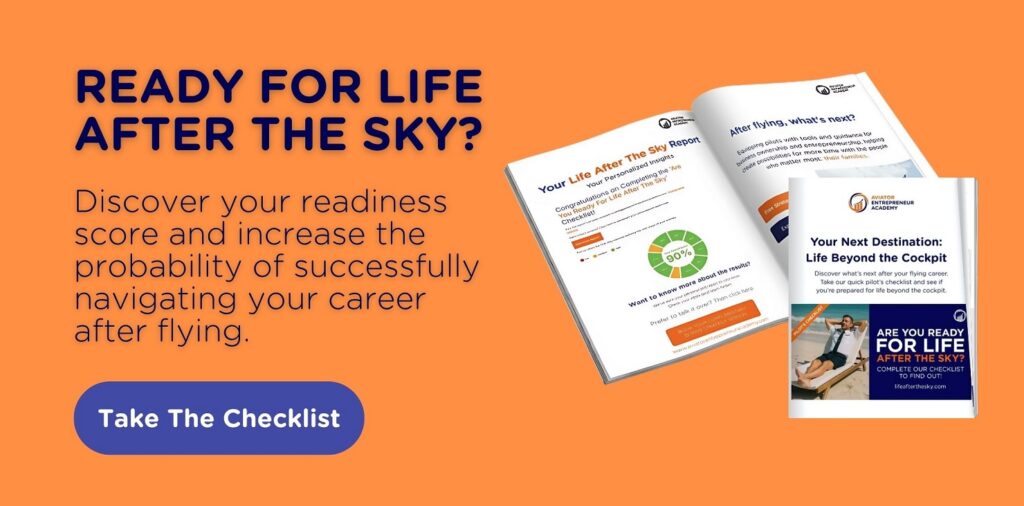
If you want a clear picture of how ready you are for the next chapter beyond flying, the Life After the Sky Checklist gives you a 25-page report in just three minutes. It highlights your strengths, shows you where you may be stuck, and helps you see the path forward
Invitation to Join Our FREE Strategy Session
Most pilots are one honest conversation away from clarity. This is that conversation.
Complete our “Life After the Sky” checklist, then join me for a FREE 15-minute “Strategy Session” via Zoom.
This session is for pilots who want to take ownership of what comes next.
Those who want action, not just to talk about it.
In just 15 minutes, we’ll:
- Review your checklist results
- Identify the one obstacle holding back your reinvention
- Translate your checklist results into a clear starting point
Start your pre-flight assessment for the next chapter of your journey by Booking your free strategy session here!