

Do you know that, as per the World Economic Forum, 44% of workers’ core skills are expected to change within five years?
This means relying only on technical expertise is becoming increasingly risky. Careers are changing faster than most people expected. Skills that once took years to build are becoming outdated in a matter of months.
However, there are a few skills that will remain resilient despite constant change. These abilities adapt across roles, industries, and technologies, making them valuable no matter how the job market shifts. Let’s take a closer look at the three skills that continue to matter most.
Key Takeaways
- Emotional Intelligence: Emotional intelligence, like communication and decision-making, is what separates high performers. This skill is hard to automate and apply across any role or industry.
- Adaptability: Adaptability helps you stay relevant. The ability to quickly learn new tools, systems, and skills is now more valuable than relying on existing knowledge.
- Ownership: Building assets like content, skills, or a business gives you control and independence. Unlike a job, ownership creates value that is not tied to one employer or system.
Why Most Skills Don’t Last Anymore
One of the biggest reasons behind this is technology. New tools, platforms, and systems are constantly replacing old ones. What used to be considered advanced knowledge quickly becomes basic, and then eventually outdated.
Employees are already feeling the impact. Research from the OECD shows that 63% of companies identify skill gaps as one of the biggest barriers to growth and transformation. This gap exists because skills are evolving faster than people can update them.
Another major factor is automation. Tasks that once required human effort are now being handled by AI and software. As a result, many technical skills tied to specific tools or systems lose value once those systems change or become automated.
The 3 Durable Skills That Actually Hold Value
Most technical skills lose value as time passes. Tools change, systems evolve, and industries shift. That is why it makes more sense to focus on soft skills that continue to grow stronger instead of fading away.
The three areas below stand out because they do not depend on a single tool, company, or industry. They transfer across roles and compounds over time.
1. Emotional Intelligence
Technical ability can get someone into a role, but how they communicate, lead, and respond under pressure determines how effective they are. This is where emotional intelligence helps you. It includes self-awareness, empathy, communication, and the ability to manage both your own emotions and the emotions of others.
Modern workplaces increasingly value emotional intelligence as collaboration accelerates and conditions change quickly. Professionals are expected to make sound judgments in uncertainty, manage stress, and work with diverse personalities.
Studies show that nearly 90% of top performers demonstrate high emotional intelligence, which highlights its strong link to real-world performance, especially in high-responsibility roles.
A major strength of emotional intelligence lies in its lasting relevance. While technology and data continue to advance, human judgment in tense situations and the ability to read people remain irreplaceable.
2. Adaptability
When environments change quickly, the ability to learn and adjust becomes more valuable than any single skill. Adaptability is about how fast you can understand new systems, adjust your approach, and stay effective in unfamiliar situations.
This is no longer optional. According to LinkedIn’s Workplace Learning Report, 89% of learning and development professionals say that building new skills proactively is critical for navigating change.
Moreover, adaptability shows up in simple but important ways. Picking up a new tool without resistance, adjusting to a different workflow, or learning something completely outside your original field all require the same core ability.
Interestingly, many professionals already have this skill without realizing it. You can easily strengthen this capability by learning new procedures, adapting to different teams, or handling unexpected changes. When used broadly, it allows people to move between roles, industries, or opportunities without being limited by a single path.
3. Ownership
Ownership creates a completely different kind of advantage because it is not tied to a specific role or employer. It gives you something that exists independently and continues to provide value without depending on a single system.
This could include content, courses, intellectual property, a business, or even a specialized body of knowledge that is packaged and shared.
The importance of ownership is visible in broader economic data. According to statistics, small businesses account for 99.9% of all businesses in the United States.
What makes ownership powerful is control. When you own something, decisions made by an employer or changes in a single system have less impact on your overall position.
How to Start Building These Skills Today
You do not need a complete career shift to start building these skills. As a pilot, you do have most of these; you need to figure out the right way to use them. Just keep it simple, track progress, and build one habit at a time.
1. Emotional Intelligence
Focus on how you communicate and respond, not just what you do. Simple, consistent habits can strengthen these skills over time.
- After any meeting or interaction, write down one thing you did well and one thing you could improve.
- Ask one open question in conversations and listen fully before replying.
- When tension rises, pause for a few seconds before responding and choose a clear, calm answer.
2. Adaptability
Your goal is not to learn everything; it is to get faster at learning new things. For this, you can do the following:
- Pick one new tool or skill every month and learn the basics within 7 days.
- Set a 20-30 minute daily learning block and keep it consistent.
- Use “learn and apply” cycles, learn something small, and then use it immediately.
3. Ownership
Ownership does not require a business on day one. All you need to do is start creating something that is yours. Follow the points below to start building this skill.
- Document what you already know and turn it into simple content, notes, or guides.
- Share one useful idea per week on a platform or with a small audience.
- Package one skill into a basic format, a checklist, a short guide, or a mini course.
Build Your Next Chapter Before You Need It
The safest move right now for you is to prepare for the future. You don’t need a complete plan to get started. Focus on small actions, improve how you communicate, and learn something outside your current role.
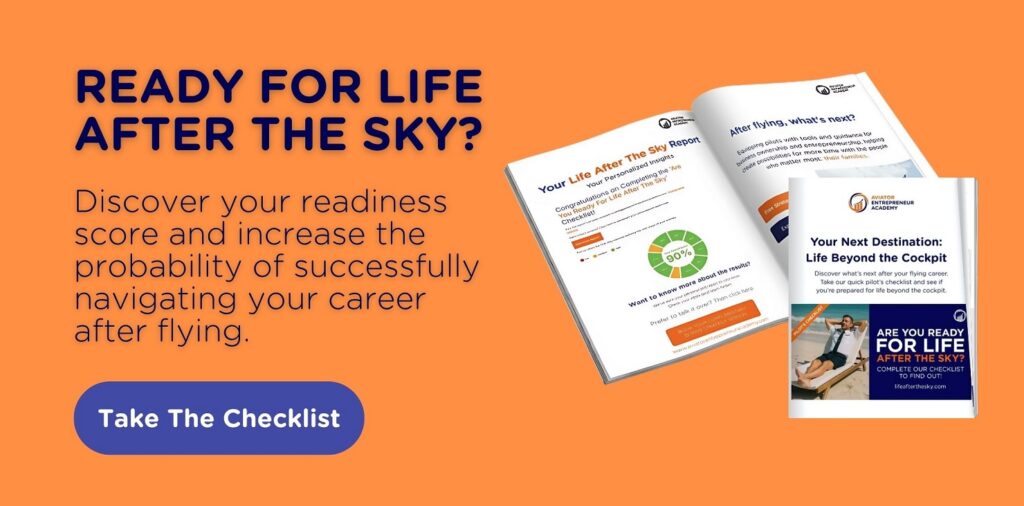
Many pilots already have the foundation for these advantages. However, if you still want a clearer starting point, our Life After the Sky checklist can help.
It gives you a structured way to understand your current position, identify gaps, and take practical steps toward building a more secure and flexible future beyond flying.
Invitation to Join Our FREE Strategy Session
Most pilots are one honest conversation away from clarity. This is that conversation.
Complete our “Life After the Sky” checklist, then join me for a FREE 15-minute “Strategy Session” via Zoom.
This session is for pilots who want to take ownership of what comes next, not just to talk about it.
In just 15 minutes, we’ll:
- Review your checklist results
- Identify the one obstacle holding back your reinvention
- Translate your checklist results into a clear starting point
Start your pre-flight assessment for the next chapter of your journey by Booking your free strategy session here!