


Right now, the future feels strangely familiar and strangely uncertain at the same time. Things that once seemed reliable now shift before we even finish thinking about them. That makes stability feel less like a promise and more like a memory.
Most people respond to that by clinging to what feels safe. They tighten their grip on familiar routines. What if this uncertainty isn’t something temporary and is now the baseline of the world that we live in?
In the sections ahead, we’ll explore why uncertainty isn’t the enemy and how your next chapter might be waiting in the very place that you’ve been resisting.
Key Takeaways
- Stability Is Gone: Change is faster now, and old assumptions about long-term certainty no longer match reality.
- Pilots Know Uncertainty: Pilots manage uncertainty well in the cockpit because it comes with structure. However, career uncertainty feels harder because it lacks clear rules.
- Growth Happens Later: The future should not be judged using today’s limits. New challenges create new skills, confidence, and capability along the way.
- Use it Actively: Uncertainty becomes manageable when you act early, focus on what you control, test ideas in small steps, and treat discomfort as useful feedback.
The Era of Uncertainty
For a long time, stability felt like a reasonable expectation. Careers followed predictable paths, pilot skills stayed relevant for decades, and identity was closely tied to a single role or profession. Though all of this is breaking down.
Technology is reshaping work faster than institutions can adapt. Skills that were once defined as competence are being replaced or reshuffled. Even the ideas of a linear career, learning once and applying forever, no longer fit how the world actually works.
The philosopher Heraclitus captured this idea centuries ago when he said,
“No man ever steps in the same river twice, for it’s not the same river and he’s not the same man.”
The world is changing, and so are the people moving through it.
This is a signal that old assumptions about stability, progress, and identity no longer match reality.
Aviation’s Relationship With Uncertainty
Pilots are not strangers to uncertainty. From the first day of training, they learn to expect it. Weather shifts, mechanical issues arise, flight plans change, and decisions have to be made with incomplete information.
What makes aviation different is that uncertainty is now managed. It exists inside clearly defined boundaries. There are checklists, SOPs, and decision frameworks that create a structure around variables that cannot be eliminated.
Because of this, pilots become very good at handling uncertainty as long as the parameters remain stable.
The real challenge arises when uncertainty moves outside those boundaries. Career uncertainty doesn’t come with checklists. There are no standard operating procedures for identity shifts or changing industry dynamics.
The Catalyst Principle
Uncertainty is usually framed as something that disrupts progress. In reality, it often does the opposite. External disruption creates the conditions for internal change, not by choice, but by necessity.
One thing that most people miss is that uncertainty not only changes circumstances, it also changes the person moving through them. In fact, cognitive scientist Maya Shankar explains this clearly when she writes:
“The unique stresses and demands of being thrust into a new reality can uncover unexpected and astonishing insights about ourselves and the world around us.”
Seen this way, uncertainty stops being a threat to who you are. It becomes part of the process that forms who you are becoming.
The Mistake Most People Make
The mistake most people make when they think about the future is subtle. They imagine tomorrow’s challenges being handled by today’s version of themselves, with the same skills, confidence, and limits.
When the future looks demanding through that lens, overwhelm feels inevitable. That reaction makes sense because current-you is not designed for problems that have not arrived yet.
What mostly gets overlooked are the experiences between now and then. That space is not empty; it is filled with experiences, adjustments, and small adaptations that quietly reshape capability. The person who faces future uncertainty will not be the same person imagining it today.
This is why, as a pilot, you should not project your stress forward. It compresses growth out of the picture and assumes stagnation where none exists.
How to Use Uncertainty Instead of Fighting It
Here’s how you can use uncertainty as a weapon rather than fighting against it as a pilot:
1. Stop Waiting for Certainty
Start acting before things feel clear. Do not wait for confidence, permission, or perfect timing. Instead, choose one small action that moves you forward and commit to it.
This could mean learning a new skill, starting a side project, or exploring an idea in a low-risk way. Once you take action, pay attention to what you learn. That information will guide your next step.
2. Focus on What You Can Control
Shift your attention away from things you cannot influence. Stop trying to predict how industries will change and when stability will return. Rather, invest time in areas you control.
Moreover, build skills that transfer across roles and strengthen your ability to learn quickly. Don’t forget to improve how you make decisions under pressure. These actions create flexibility, which reduces uncertainty.
3. Run Small Experiments
Break big decisions into small tests. However, do not commit everything at once. Try ideas in limited ways. Set clear boundaries around time, effort, and risk.
After each experiment, review the outcome honestly. Based on that, decide what worked, what did not, and what to adjust. Each experiment replaces fear with evidence, which makes uncertainty easier to manage.
4. Treat Discomfort as Data
When something feels uncomfortable, pause instead of pulling back. Ask what the discomfort is pointing to. Identify whether it signals growth, a skill gap, or an outdated assumption. Then, respond deliberately.
Develop the skill, adjust the approach, or update the assumption. Discomfort often highlights exactly where progress is possible.
Use Uncertainty as the Training Ground
Uncertainty is no longer a temporary condition you wait to pass. It is the environment you are already operating in. When you take small actions, focus on what you control, and let experience guide you forward, uncertainty stops feeling like a threat.
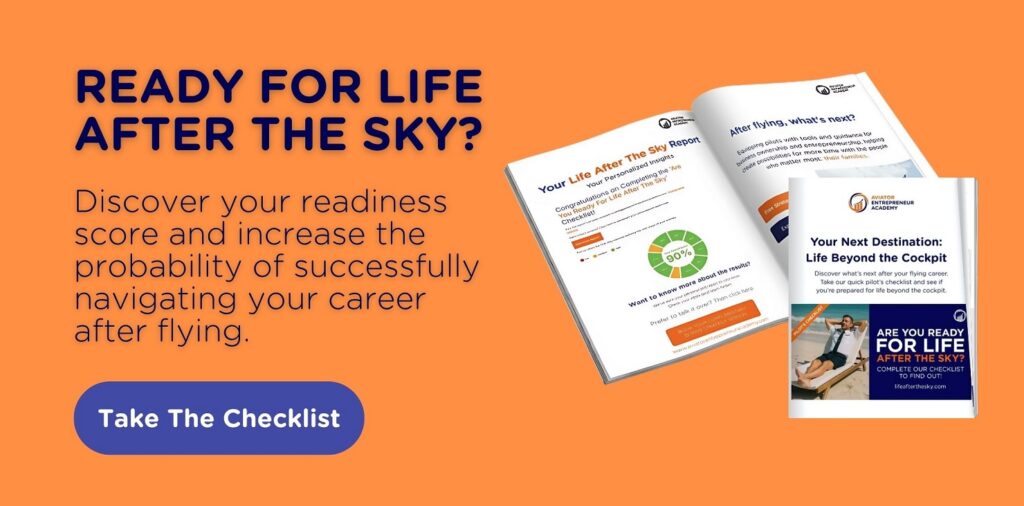
In such an uncertain situation, clarity is usually the missing piece. This is where the Life After the Sky checklist helps.
It shows where you lack, the areas that deserve attention now, and how you can move forward without guessing.
Invitation to Join Our FREE Strategy Session
Most pilots are one honest conversation away from clarity. This is that conversation.
Complete our “Life After the Sky” checklist, then join me for a FREE 15-minute “Strategy Session” via Zoom.
This session is for pilots who want to take ownership of what comes next, not just to talk about it.
In just 15 minutes, we’ll:
- Review your checklist results
- Identify the one obstacle holding back your reinvention
- Translate your checklist results into a clear starting point
Start your pre-flight assessment for the next chapter of your journey by Booking your free strategy session here!