


In 2002, Elon Musk was told a rocket would cost $65 million. If it were someone else, they would have just accepted that number and walked away.
However, Elon didn’t do that. Instead, he asked what a rocket was made of, and the answer changed everything. As pilots, we face the same moment when we start thinking about a career transition.
To make sure you don’t have to go through what I did, we’ll explore why we assume and how to break down those assumptions.
Key Takeaways
- Assumptions Inflate Cost: When problems are broken down to fundamentals, many barriers turn out to be far smaller than assumed.
- Aviation Mindset: Pilots are trained to follow proven patterns for safety, which works in the cockpit but limits thinking during career transitions.
- Overpriced Transitions: Money, time, credentials, and risk are commonly overestimated. Most transitions can be explored gradually, alongside flying.
- Think First-Principles: Clear decisions come from defining the real constraint, stripping assumptions, rebuilding from facts, and testing in small steps.
The $65 Million Assumption
When Elon Musk wanted to send a rocket to Mars, he was given an estimate of $65 million by Russian suppliers.
Now, rather than stepping back, he did something smart. He started asking about how the rocket was made, the materials used, and anything necessary. And when he calculated the cost of those raw materials, the number came out closer to $2 million.
That $65 million-to-$2 million gap was all because of the assumption that rockets must be expensive.
Once the assumption was removed, a new option appeared. If the materials were affordable, the rocket itself could be built differently. That insight led to the creation of SpaceX, which now builds rockets at a fraction of the cost.
First-Principles vs. Aviation Thinking
Pilots are trained to think by analogy. In the cockpit, questioning assumptions is dangerous, so following what has been done before becomes second nature. That same mindset becomes limiting when applied to a career transition.
First-principles thinking works in the opposite direction. Aristotle described it as breaking a problem down to what is undeniably true and rebuilding from there.
Aviation culture reinforces analogy thinking for a reason. It’s because 60-80% of aviation incidents occur due to human factors. This is why strict procedures dominate training and prevent pilots from questioning assumptions.
Career transitions require a different mode of thinking. Instead of copying what exists, first-principles thinking asks what is fundamentally required. Once that shift happens, many perceived barriers begin to shrink.
The Career Rockets Pilots Overprice
A transition feels expensive because the price is framed by assumptions. When those assumptions go unchallenged, the move looks risky, time-consuming, and out of reach. Here are the different assumptions pilots usually have:
1. The Money Assumption
Many pilots assume a transition requires large upfront capital. That belief usually comes from comparing themselves to traditional businesses or high-profile success stories. In practice, most early-stage paths require modest costs spread over time.
2. The Time Assumption
Another common belief is that meaningful progress requires stepping away from flying. This overlooks how fragmented time actually works. Layovers, days off, and short, focused sessions add up when used deliberately. Remember, progress comes from consistent, protected hours used with intention.
3. The Credentials Assumption
Many pilots believe formal qualifications are mandatory before they can start. Degrees, certifications, or titles feel like entry tickets. In reality, most value creation starts with understanding a problem and offering a useful solution. Skills can be built while doing the work. Credentials may help later, but they are rarely the starting point.
4. The Risk Assumption
Risk is often framed as an all-or-nothing decision. Either stay flying or leap into something new. That framing exaggerates danger. Real risk reduction usually comes from parallel building, where income streams are tested alongside an existing salary.
Simple First-Principles Framework for Pilots
A first-principles framework helps you slow the problem down, separate facts from beliefs, and make decisions based on what is actually true. Follow the steps below to adapt to this thinking process.
Step 1: Define the Real Constraint
Start by naming the exact problem you think is stopping you. Avoid broad labels like dissatisfaction or burnout. Your focus should be on the specific limitation, whether it involves income stability, time availability, confidence, skills, or perceived risk.
Here, precision plays an important role. It’s because you cannot solve a problem that remains vague.
Step 2: Strip the Problem to Fundamentals
Once the constraint is clear, break it down to undeniable truths. Look at what you actually have access to, such as available hours, current skills, learning capacity, financial runway, and responsibilities.
At this stage, ignore industry norms and stories from others. Your goal should be to separate facts from inherited assumptions.
Step 3: Rebuild Without “Normal” Rules
With fundamentals laid out, begin reconstructing the path forward without relying on what is commonly done.
Consider what becomes possible when progress happens gradually, and alongside your current role. Ultimately, by removing assumed rules, you often reveal options that were previously invisible.
Step 4: Test Before You Commit
Instead of making a single high-stakes decision, use small experiments to reduce uncertainty.
Limited time, controlled effort, and clear boundaries provide real feedback. Evidence gathered this way replaces imagined risk with understood risk.
The Assumptions You Haven’t Questioned Yet
The most limiting constraints are rarely obvious. They sit quietly in the background, shaping decisions without ever being named. Because they feel normal, they go unchallenged, even when they quietly block progress.
Author James Clear captured this problem well when he wrote:
“You don’t rise to the level of your goals. You fall to the level of your systems.”
Unquestioned assumptions function like invisible systems. They quietly define what you attempt and what you miss. As soon as those assumptions are surfaced and examined, many of the limits they created begin to loosen.
Challenge the Assumptions Before You Make the Move
Before changing direction, change how you think about the problem. Assumptions inflate cost, exaggerate risk, and make options disappear. Once those assumptions are questioned, decisions become clearer and far less intimidating.
However, if you feel unsure about what comes next, clarity is usually the missing piece.
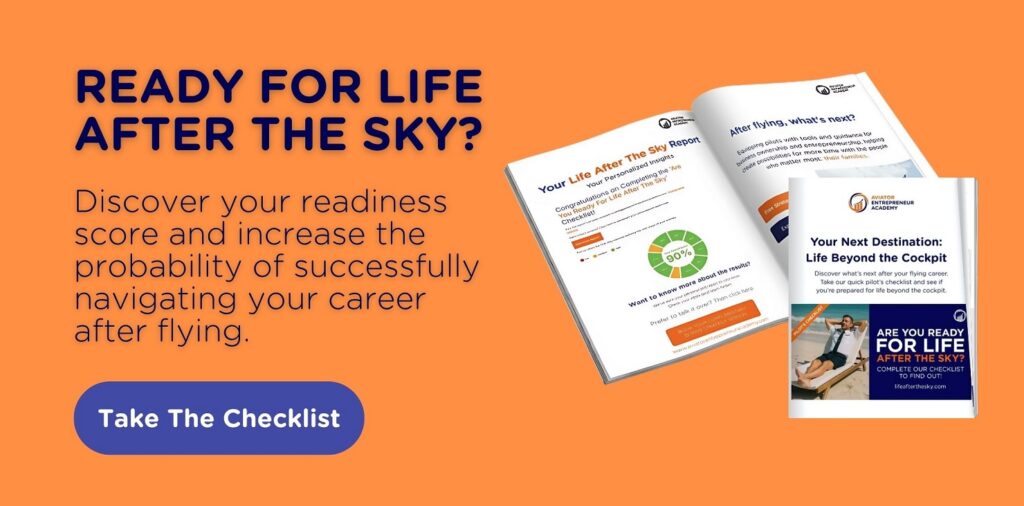
That is where the Life After the Sky checklist helps. It breaks uncertainty into concrete areas. It also highlights hidden constraints and shows what needs attention before making bigger career decisions.
Invitation to Join Our FREE Strategy Session
Most pilots are one honest conversation away from clarity. This is that conversation.
Complete our “Life After the Sky” checklist, then join me for a FREE 15-minute “Strategy Session” via Zoom.
This session is for pilots who want to take ownership of what comes next, not just to talk about it.
In just 15 minutes, we’ll:
- Review your checklist results
- Identify the one obstacle holding back your reinvention
- Translate your checklist results into a clear starting point
Start your pre-flight assessment for the next chapter of your journey by Booking your free strategy session here!